Dylan Goes AI!
What's on Bob Dylan's Patreon — and how should we feel about it?

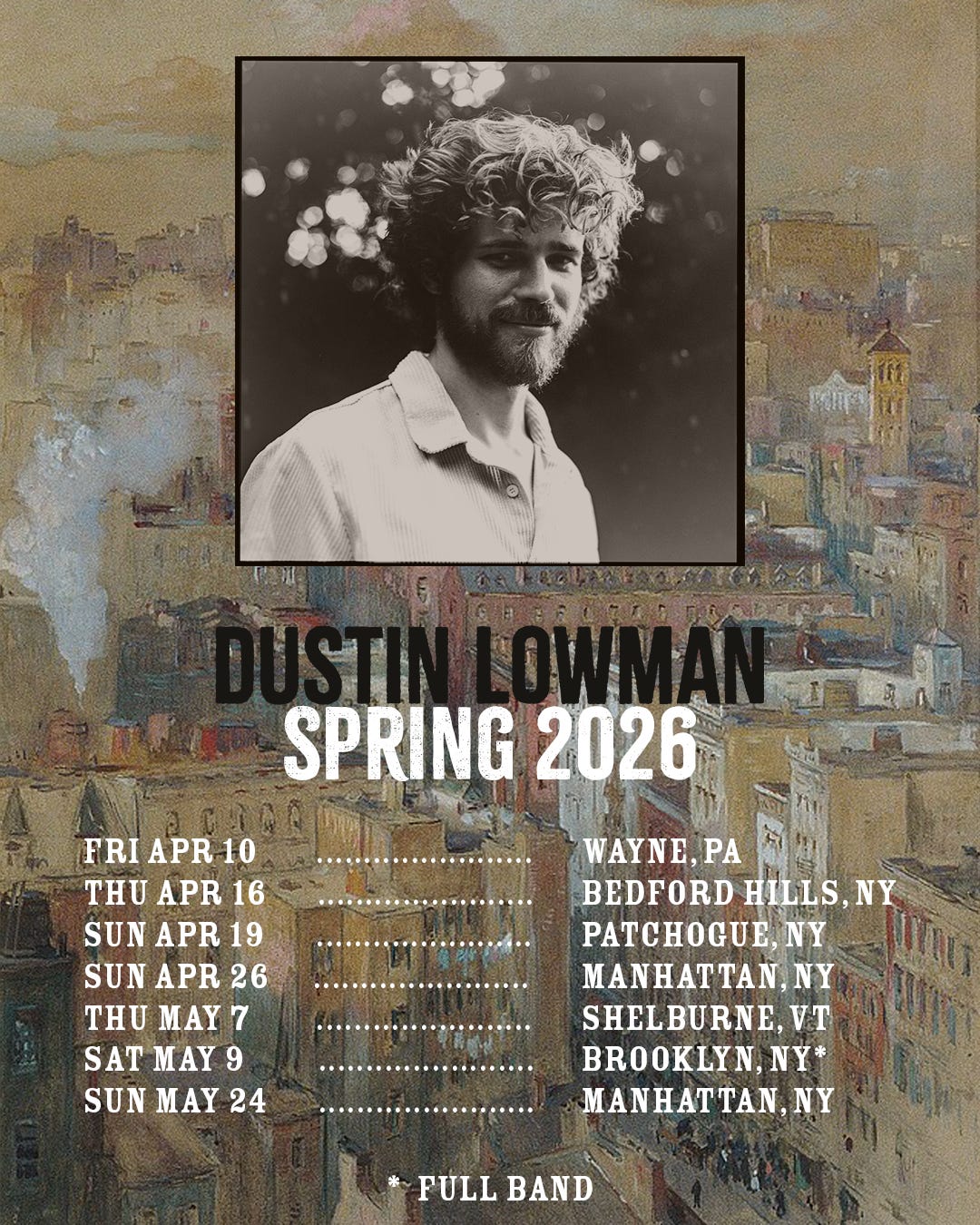
Upcoming Shows
Friday, 4/10 | 118 NORTH | Wayne, PA | 5:00 PM (TICKETS)
Thursday, 4/16 | The Bedford Barn | Bedford Hills, NY | 7:30 PM (RSVP)
Sunday, 4/19 | Down By The Creek | Patchogue, NY | 3:00 PM (RSVP)
Sunday, 4/26 | American Storytellers: Bob Dylan & Bruce Springsteen @ Cafe Wha? | Manhattan, NY | (TICKETS)
Dylan Goes AI!
In 1965, Bob Dylan angered his fans by plugging in an electric guitar. His new songs bore little resemblance to the songs that had made him famous: The lyrics had changed from explicitly topical to vexingly surreal, and his voice had turned from a humble plaint into a reedy sneer. Folk purists turned away in droves, or else lingered long enough to liken him to the betrayer of Christ.
In 1979, perhaps influenced by an echo of that former fan’s indictment, Bob Dylan angered his fans by writing songs driven by Christian doctrine. These Dylan new songs bore little resemblance to the songs that had made him famous: The lyrics had gone from humanist to theist, and the man who had once warned of “Flesh-colored Christs that glow in the dark” now urged audiences to wake up before His imminent return. Naysayers left the shows in droves, lamented his proselytizing and otherwise declaring him a stinker.
On Easter Sunday, April 5, 2026, Bob Dylan once again angered his fans by doing the unthinkable: starting a Patreon ($5/mo), and filling it with apparently AI-generated work. This new work bore little resemblance to the work that had made him a Nobel Laureate: His singing voice had been replaced by the voices of Jack London, Frank James, and others; his poetic voice had been replaced by impressions of James Baldwin, Mark Twain, and others; and the intellectual center of the work seemed to have moved from his own brain to all humanity’s collective literary knowledge, as represented by some large language model (LLM). Naysayers, among them Rebecca Slaman, cohost of the Definitely Dylan podcast, dismissed the work as an artistic betrayal: “Why does he need to release slop that doesn’t even sound like his voice or the voice of the people it’s about?” Rebecca wrote to me in a text. “He is a great writer and this is so beneath him.”
Others suggested that, by taking this work seriously, we’re falling into a decades-old Dylanologist trap. “He’s doing the only consistent thing he’s done in his long and varied career- troll us,” Laura Beth (of Girl Love) wrote to me in an Instagram message. “Gotta be him trolling,” Leo Lovechild wrote to me via the same medium. Were this true, it wouldn’t be the first time that Dylan, in the grand tradition of Andy Warhol, produced work we’re kind of supposed to react to as “not real art,” and then ask ourselves what the hell we mean by “real art,” anyway.
Well, I took the bait. What follows here is an explication of what’s actually on Dylan’s Patreon page, whether it’s any good, and what it means vis-a-vis the growing intrusion of AI on the world of artmaking.
What’s On Bob Dylan’s Patreon (And Is It Any Good)?
At the time of writing, this is the work on Bob Dylan’s Patreon page:
Two installments of a series called “Letters Never Sent,” one from James Baldwin to Walt Disney, one from Mark Twain to Rudy Valentino
First-person faux-autobiographies “spoken” by the AI-generated voices of Frank James (Jesse James’s brother), Aaron Burr, Wild Bill, and Jack London
Two short stories: “Bull Rider” (attributed to Marty Lombard) and “Frozen Pizza” (attributed to Anthony Swilly)
A video of Mahalia Jackson singing “Give Me That Old Time Religion” on the Ed Sullivan Show (not Dylan-generated)
For your benefit, I consumed most of this work. For Dylan’s benefit, I did so with maximal benefit of doubt: Nowhere does it explicitly say that the work was generated by AI, and so I consumed it as if it weren’t.
Even with that probably undue generosity, the work is mostly forgettable. Some of it is straight-up bad, like the simile-happy short story “Bull Rider,” which reads like an eighth-grader’s first attempt at fiction: admirable but deeply flawed. The best of it is memorable if perplexingly inessential, like “Jack London Tells His Story,” a faux-autobiography “spoken” by the famed writer of The Call Of The Wild, White Fang, and dozens of other books. I remember many of this story’s details, and its theme of experience over safety echoed through my head as I sat in a daylong meeting for a job I never thought I’d have, and that I’ve somehow had for nearly four years. I wouldn’t have learned about Jack London’s life otherwise, and I’m grateful for the knowledge. But I also can’t say that the best way to get this knowledge was by feeding Bob Dylan’s (likely) AI habit $5/month.
The “Letters Never Sent” series also has some memorable turns of phrase, as when James Baldwin excoriates Walt Disney: “You have taken the oldest American impulse—the refusal to look at what one has done—and given it a soundtrack, a color palette, and a procession of smiling animals.” This, and Mark Twain’s letter to Italian film star Rudy Valentino, are probably the best of the bunch, the times when it’s easiest to forget that Claude, not Bob, is probably behind this work. One imagines that Bob might have edited Claude’s first drafts; whether he did or didn’t, the mere plausibility of it gives the letters a granule of artistic intrigue.
Still — and this will surprise no one — none of the work stands anywhere near Dylan’s best. By this I mostly mean his songs, but I also mean his 2004 memoir, Chronicles, Volume I, whose homespun style was every bit as hypnotic as “Tangled Up In Blue,” and to a lesser extent, his all-too-short-lived Sirius XM show Theme Time Radio Hour. Quality-wise, the work on his Patreon sits closer to the satirical magazine covers he made back in 2012 after, probably, one of his grandkids taught him about Photoshop.
So, What Do We Make Of BobGPT?
The most generous take would be to consign his Patreon to the Isle of Misfit Bob Dylan Art Projects, a zone of cute, artistically forgettable misfires like those magazine covers, The Philosophy of Modern Song, most of his paintings, and his metal gates. This take depends on thinking of AI-generated art as something other than a gross deformity, a valid art form you can either be good or bad at.
More realistic, however, would be to dismiss it with something like hostility. The primary reason for this is that it will cast a shadow over all future Bob Dylan work: It will be impossible to say with certainty that future Bob Dylan songs weren’t in some way touched by AI.
That matters not because I think of all AI as a gross deformity — far from it. It’s very at home in the worlds of science and engineering, where it has done things like discover and provide open access to more than 200 million protein structures (AlphaFold) and make a self-driving-car-fueled (i.e. safer) future plausible. Where an empirical outcome can be linked to social good, I take a by-any-not-unconscionably-evil-means-necessary view on the expedition of that outcome’s arrival.
In theory, I don’t even think of AI as wholly unwelcome in the world of art. There is a utopian world of artmaking where, like the electric guitar in did “Like A Rolling Stone” or the synthesizer did in “Baba O’Riley,” AI plays a supporting but essential role in helping a work of art reach heights it couldn’t have reached otherwise. A good example would be how AI honed Adrien Brody’s Hungarian accent in “The Brutalist,” the revelation of which had no impact on how I felt about the film or on Brody’s Oscar chances. I’m sure this is how Bob Dylan is thinking about it: Suddenly, we’ve got all the human thought ever committed to language available to us in the form of LLMs, and we can use simple prompts to dispense it in an infinite range of forms. In this sense, and especially when wielded by master craftspeople, it almost feels miraculous.
But in practice, AI tools have enabled people to bypass the sacrifices of craft altogether and flood the already flooded channels of the internet with craftless slop. Like the proliferation of non-nutritious food, the proliferation of insubstantial art is intrinsically bad, as it subjects human beings to the Devil’s bargain of exchanging soul-enrichment for dopamine addiction. It also adds yet more noise for good art to break through, and, in the case of music, it diverts yet more of those few evaporating revenue streams away from considerate craftspeople.
Moreover, unless an artist explicitly spells out how they used it, it’s impossible to determine how exactly AI contributed to a work of art. In “Baba O’Riley,” you know exactly the part the synth plays, and you can watch Pete Townshend build it. In Bob Dylan’s letter from James Baldwin to Walt Disney, it’s not easy to tell where the LLM ends and where Dylan, or Baldwin, or whomever we’re supposed to attribute the letter to, begins.
Maybe you’d say this is just the inevitable coming of the Turing Test to the art world, and if you can’t tell the difference, it doesn’t matter. With empirically motivated work, I’d agree with you; the quality of an outcome is utilitarian in nature, and doing more social good justifies the usage of AI, whether or not we know what it did. But with art, whose motivations are fundamentally subjective, it does matter. I liken it to the A Million Little Pieces scandal, where, upon learning that much of James Frey’s story was fictionalized, audiences who thought they were reading a memoir were outraged. The writing didn’t change, but the framing did, and it was enough to nullify readers’ experience of catharsis. Likewise, learning that a song I like is actually an unfeeling robot’s imitation of the human yearning it takes to write a song would make me hear it differently, would make me identify less.
Part of me wants to call for the discontinuation of all AI tools in artmaking. But not only is that unrealistic, it also smacks of old-fogeyism; I love the electric guitar in “Like A Rolling Stone,” I love the synth parts in “Baba O’Riley” and “Won’t Get Fooled Again,” and I love that I can hear recordings of these songs. Up to a point (that ends, by the way, where internet streaming begins), I appreciate technology’s role in the creation and dissemination of these songs.
More realistically, and to echo what I said in a newsletter last year, I want to call for transparency around how AI tools contribute to works of art. I want Spotify to put clickable “Made with AI” labels on songs, and when I click them, I want an outline of what AI’s doing. I can imagine the objection that the creators of these songs would be dishonest about how they used AI; the truth of that is further reason why these labels should exist. Creators know that AI will change how audiences respond to their “work.” Good: That should be creators’ burden, not audiences’.
Regarding Bob Dylan’s Patreon, no, you’re not missing anything essential by not signing up, and I think that, for whatever fun he might be having as an old dog learning new tricks, he is harming our appreciation of whatever future work he might make. Regarding the usage of AI in art more broadly, all I want is the truth. I want the facts to be able to consent to an experience of catharsis, not to be deluded by the vapors of a robot-engineered dream.
Bravo for a thoughtful response-and of course for having written it yourself (and not letting AI do the heavy lifting)!